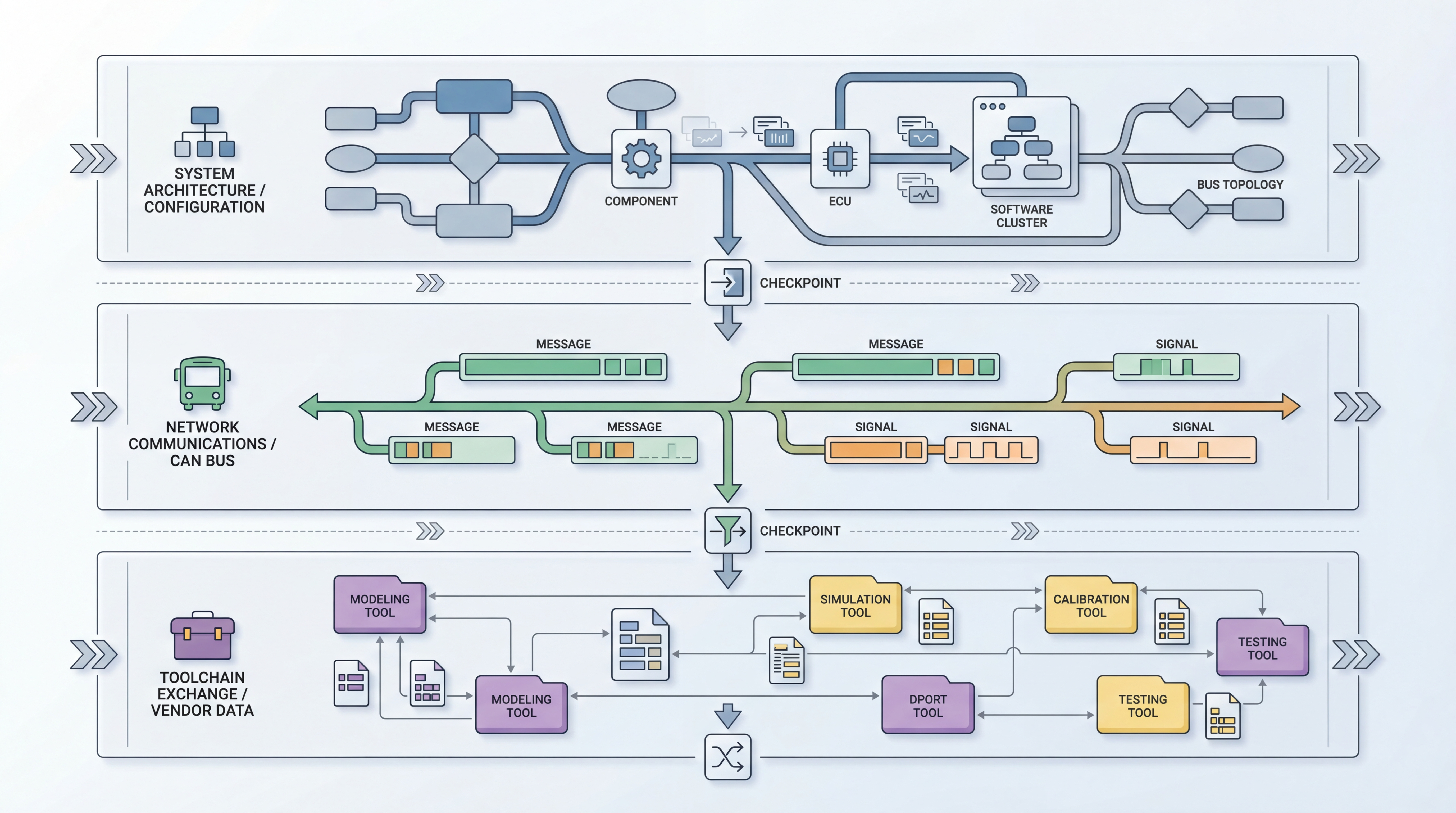
Why format confusion slows teams down
Automotive projects often fail in handoff points, not in core logic. One recurring reason is format confusion: teams use one file type for problems it was never designed to solve. ARXML, DBC, and XCD/XDD-style artifacts can coexist, but only when their boundaries are clear.
Where ARXML fits
ARXML (AUTOSAR XML) is configuration-heavy and architecture-oriented. It commonly represents software components, interfaces, communication mapping, and ECU/system descriptions within AUTOSAR workflows.
In short: ARXML is usually closer to platform/system configuration than day-to-day CAN trace decoding.
Where DBC fits
DBC is CAN message database modeling. It is ideal for defining and interpreting CAN/CAN FD messages and signals in analysis, debugging, and validation contexts.
In short: DBC is the practical language of CAN payload meaning.
What about XCD or XDD
XCD/XDD usage depends on toolchain and OEM context. In many environments, these files are used for structured data exchange in specific engineering workflows (for example, calibration/configuration or proprietary integration layers).
Because naming and semantics can vary by vendor ecosystem, teams should document local definitions explicitly and avoid assuming universal behavior.
A practical boundary model
A simple operating model that scales:
- Use ARXML for AUTOSAR system/software configuration flow
- Use DBC for CAN/CAN FD signal database exchange and decoding workflows
- Use XCD/XDD where your selected toolchain specifically requires it
Then define conversion/handoff checkpoints so one format does not silently overwrite intent from another.
Common interoperability mistakes
Watch for these:
- treating ARXML as if it were a replacement for DBC decode workflows
- maintaining duplicate signal definitions without ownership rules
- undocumented format transformations in CI pipelines
- no review gate for cross-format changes
Recommended process guardrails
- assign clear format ownership by team
- keep mapping tables for cross-format fields
- review transformed outputs with semantic diff, not text-only diff
- maintain a release note trail for format conversions
Where dbcUtility helps
For the DBC side of this mixed-format world, a focused editor and compare workflow helps keep CAN database changes visible and controlled, especially when inputs come from larger AUTOSAR-driven programs.
Product pages:
Migration note: mixed-format programs
In programs migrating from legacy vendor formats to AUTOSAR-heavy workflows, the safest approach is phased ownership:
- phase 1: freeze a trusted DBC baseline and document ownership
- phase 2: define explicit ARXML to DBC mapping rules
- phase 3: automate transformation checks in CI
- phase 4: enforce cross-format sign-off before release
This avoids silent drift between architecture-level and signal-level artifacts.
Internal reads for deeper context
Related reads in this library:
- What are DBC files, where are they used, and how teams actually work with them
- How DBC signal encoding and decoding works
Final view
The winning strategy is not choosing one format forever. It is using each format at the correct layer and enforcing explicit handoffs. That is how teams keep architecture intent, signal correctness, and release predictability aligned.