The real cost of choosing the wrong tool
In automotive programs, bad tooling choices do not fail loudly on day one. They fail slowly through review delays, poor traceability, and repeated integration defects. DBC tooling selection should be treated as process infrastructure.
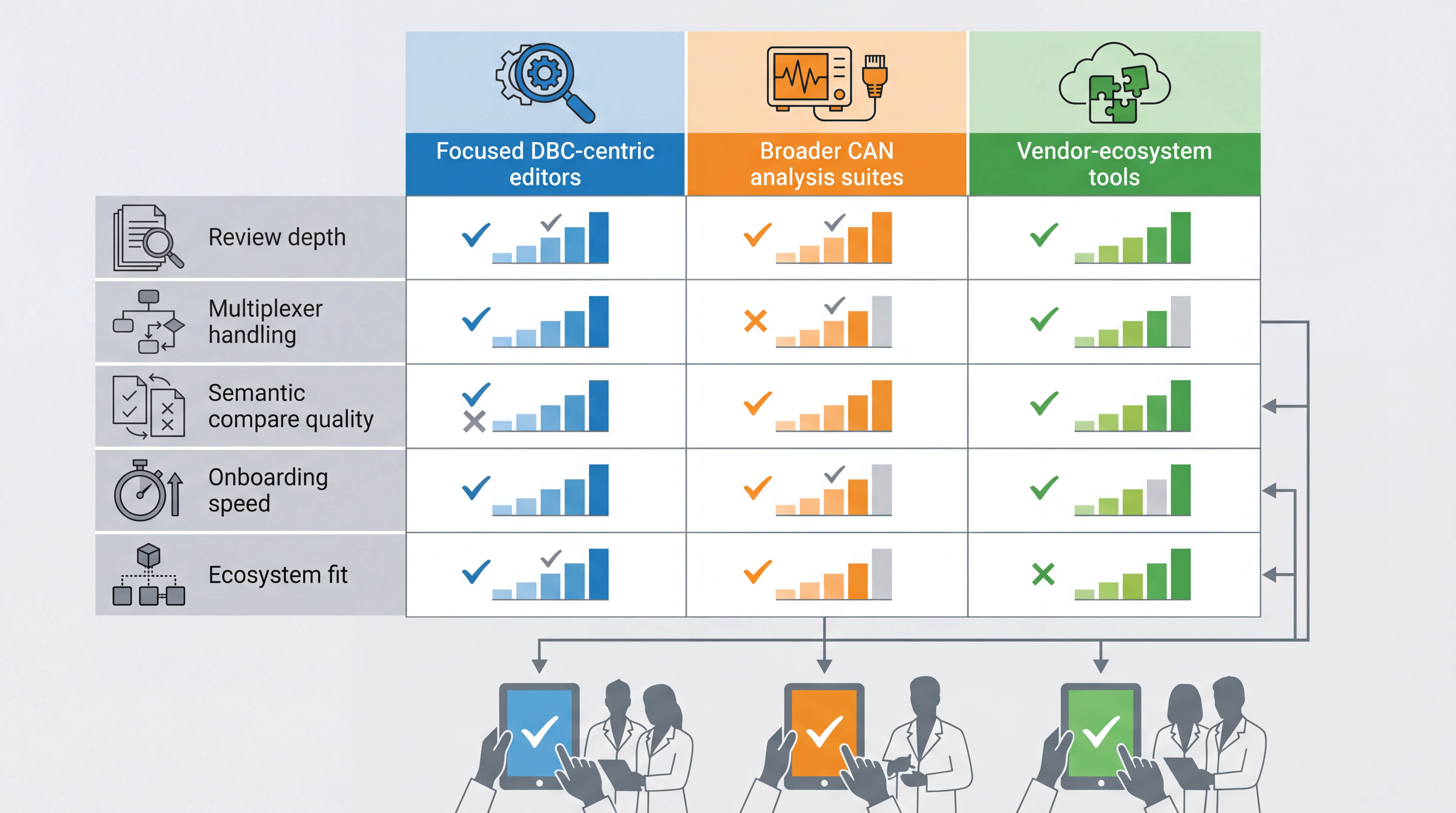
Criteria that actually matter
Before naming any product, define your required outcomes:
- review speed on frequent DBC changes
- multiplexer handling quality
- semantic compare depth
- integration with existing validation and release flow
- licensing and ecosystem constraints
Without criteria, teams over-index on familiarity.
Common option categories
Most teams compare three categories:
- focused DBC-centric editors
- broader CAN analysis suites
- ecosystem-anchored vendor tools
Each can be right depending on your primary workload.
When focused DBC tooling is the better fit
A focused DBC tool usually wins when:
- the DBC is your daily artifact
- your main pain is review quality, not hardware orchestration
- you need fast semantic change visibility
- you prefer a lean desktop workflow
dbcUtility is positioned in this category with view/edit/compare and multiplexer-aware workflows.
When broader suites may win
Broader suites can be better when:
- simulation and logging depth dominate your workload
- hardware vendor integration is central
- your team already invested heavily in a single vendor environment
In that case, DBC editing is one piece of a larger system.
A practical scoring model
Use a simple weighted score (1–5) for each candidate:
- DBC review depth
- multiplexer support
- compare usability
- onboarding speed
- ecosystem fit
- cost/licensing clarity
Then run a one-week pilot on real files before final selection.
Why this matters for release quality
The right tool reduces churn in exactly the places that delay releases:
- fewer ambiguous signal edits
- better pre-merge review confidence
- stronger traceability across versions
- cleaner collaboration between integration and validation teams
dbcUtility product links
Pilot plan you can run in one week
To avoid biased selection meetings, run a one-week pilot with real artifacts:
- Day 1: import existing DBC set and baseline versions
- Day 2: execute normal edit/review flow with two engineers
- Day 3: run compare against a noisy feature branch
- Day 4: validate multiplexer-heavy messages
- Day 5: collect decision metrics (review time, defect catch rate, onboarding friction)
This gives decision-makers evidence instead of opinions.
Internal reads for deeper context
You may also want:
Final view
There is no universal best tool. There is only the best fit for your workflow shape. Teams that choose based on actual change-review behavior, not habit, usually ship cleaner integrations with less rework.
References
- DBC Utility pricing
- DBC Utility documentation
- BUSMASTER product flyer
- SavvyCAN project information
- Kvaser Database Editor 3