LIN is not trying to be CAN
CAN engineers sometimes dismiss LIN because it is slower and simpler. That misses the point.
LIN, or Local Interconnect Network, exists because many vehicle functions do not need CAN's multi-master arbitration, robustness, and bandwidth. A mirror motor, seat switch, small flap actuator, rain sensor, steering-wheel button cluster, or HVAC damper does not always justify the cost of a full CAN node.
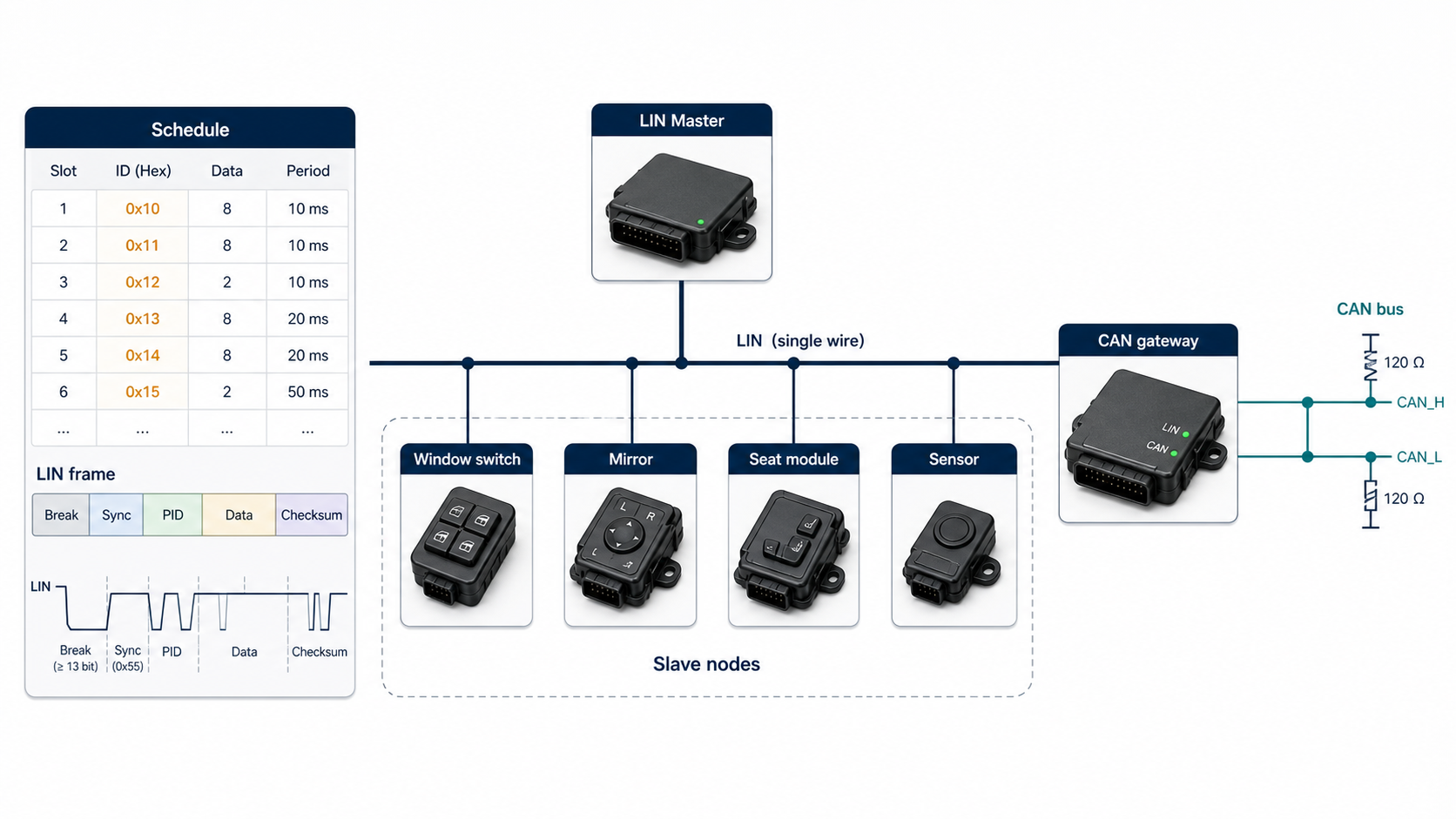
LIN is usually the economical answer for low-speed mechatronic sub-nodes. CAN or CAN FD handles the larger network. A gateway or body controller can bridge the LIN cluster into the rest of the vehicle.
The most important difference: master scheduled communication
CAN is multi-master. Any node may attempt to transmit, and arbitration decides who wins.
LIN is different. A LIN cluster has a master. The master sends headers according to a schedule. A slave responds only when the header asks for a frame it owns.
Practical consequence:
CAN:  nodes compete for the bus using arbitration
LIN:  the master decides the timing
That makes LIN predictable and cheap, but less flexible for high-priority spontaneous traffic.
What a LIN frame looks like conceptually
A LIN transaction has:
Break
Sync
Identifier
Data
Checksum
The master sends the break, sync, and identifier. The selected publisher provides the response data. Depending on the frame, the publisher may be the master itself or a slave.
This is why a passive LIN slave does not just talk whenever it wants. If you connect a logic analyzer and wait for a slave to announce itself, you may see nothing unless the master is scheduling the relevant frame.
LDF is to LIN what DBC is to CAN
LIN networks are described by LDF, or LIN Description File. An LDF includes information such as:
- nodes
- frames
- signals
- schedules
- signal publishers and subscribers
- diagnostic frames
- timing
A simplified LDF-style idea looks like:
Master: BodyControlModule
Slaves: DoorSwitch, MirrorMotor

Frame: DoorStatus
  Publisher: DoorSwitch
  Signals:
    WindowSwitchUp
    WindowSwitchDown
    DoorLockState

Schedule:
  DoorStatus every 20 ms
  MirrorCommand every 50 ms
The key difference from many CAN workflows is the schedule. Timing is part of the LIN design, not just an emergent property of node behavior.
When LIN is the right fit
LIN is a good fit when:
- bandwidth needs are small
- timing can be scheduled
- a single master can coordinate the cluster
- node cost matters
- wiring should stay simple
- the function is local to a door, seat, HVAC unit, steering wheel, or small actuator group
LIN is not a good fit when:
- multiple nodes need independent bus access
- hard real-time arbitration priority is required
- the payload is large
- the bus must handle many active producers
- gateway latency would create a control problem
CAN and LIN often work together
A common architecture looks like:
Door LIN cluster -> Door module -> Body CAN bus -> Central gatewayThe CAN network may carry a higher-level signal:
DriverWindowCommand = UpThe door module then translates that into LIN interactions with local switches, sensors, and motor drivers.
This is why vehicle network debugging is rarely "CAN only." A CAN signal can be the visible symptom of a problem that started on a LIN sub-bus.
How to debug a LIN-to-CAN issue
Use a layered checklist.
1. Is the CAN command arriving at the gateway or body controller?
2. Is the LIN master scheduling the expected LIN frame?
3. Is the LIN slave responding?
4. Is the response checksum valid?
5. Is the gateway mapping the LIN signal into the CAN signal correctly?
6. Is the DBC signal definition correct on the CAN side?
If the CAN side shows stale data, the problem may be:
- missing LIN response
- wrong LIN schedule table
- bus wiring or wake issue
- gateway mapping issue
- stale CAN DBC definition
- diagnostic state changing the schedule
Example gateway mapping
A gateway or body controller might map local LIN state into a CAN frame:
LIN signal:
  Frame: DoorStatus
  Signal: WindowSwitchUp
  Value: 1

CAN signal:
  Message: BodyControlStatus
  Signal: DriverWindowSwitchUp
  Value: 1
The CAN DBC does not necessarily tell you the LIN origin. Add comments when you know them.
Signal comment:
Derived from driver door LIN cluster DoorStatus.WindowSwitchUp.
That kind of comment saves debug time later.
Why LIN content belongs near a DBC tool
DBC Utility does not edit LDF files. But LIN still belongs in the same engineering conversation because CAN databases often include signals that are generated from LIN clusters through gateways.
If a CAN signal represents a LIN-derived value, the DBC should make that clear where possible:
- signal name should match the vehicle function
- comment should explain gateway origin
- value table should match the application states
- min/max should reflect the translated CAN value
- receiver list should identify consumers
The cleaner the CAN-side database is, the easier it is to debug multi-bus vehicle behavior.
Practical engineer summary
Use CAN or CAN FD when distributed control, arbitration, bandwidth, or robustness justify it.
Use LIN when a low-cost scheduled sub-bus can handle the job.
Use Ethernet when high data rate, switched topology, IP traffic, sensors, flashing, or central compute make the network problem larger than control frames.
Real vehicles use all of them because each solves a different problem.