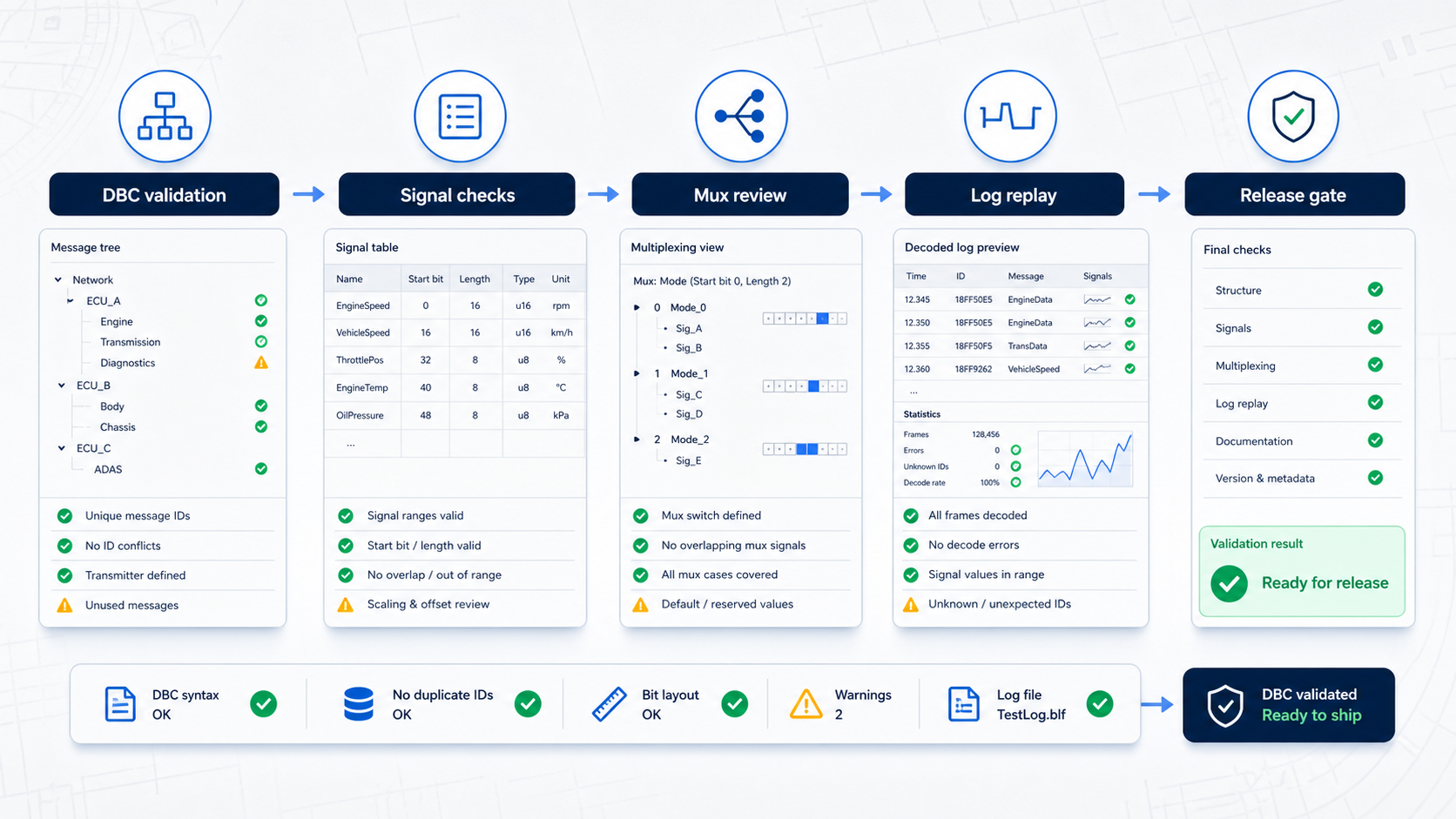
Why DBC validation matters
A DBC file is not just documentation. In most CAN and CAN FD workflows it becomes the contract between embedded software, testing, calibration, diagnostics, data logging, and analysis tools.
If the DBC is wrong, every downstream tool can still look clean while showing bad engineering values.
That is the dangerous part. A bad scale, offset, byte order, frame ID, multiplexor, or unit may not throw an obvious error. It may decode into a number that looks believable enough to waste days.
Good DBC validation catches those problems before the file is handed to other teams.
What a DBC release should prove
Before releasing a CAN database, prove five things:
- the file can be parsed by the tools that matter
- each message definition matches the real bus behavior
- each signal maps to the expected payload bits
- decoded values are plausible on real or replayed logs
- every change has a reason and a reviewer
Opening the file in a DBC editor is only the first check. A release-ready DBC needs semantic review.
Start with parser compatibility
Use more than one parser when the DBC will be shared across tools. This catches syntax that one tool tolerates and another rejects.
With cantools:
python -m pip install cantools
python -m cantools dump vehicle.dbc
With a short Python check:
import cantools

db = cantools.database.load_file("vehicle.dbc")
print(f"messages: {len(db.messages)}")

for message in db.messages:
    print(hex(message.frame_id), message.name, message.length, len(message.signals))
This does not validate engineering meaning yet. It only proves the file is structurally readable.
Check message-level consistency
Review each message before reviewing individual signals.
Useful checks:
- duplicate frame IDs
- wrong standard vs extended identifier usage
- classical CAN messages with length above 8 bytes
- CAN FD messages with unexpected payload length
- missing sender or receiver context where your team requires it
- message names that changed without release reason
- frame IDs that appear in logs but not in the DBC
- DBC messages that never appear in logs
A quick log coverage script helps:
import cantools
from collections import Counter

db = cantools.database.load_file("vehicle.dbc")
dbc_ids = {message.frame_id for message in db.messages}
seen_ids = Counter()

with open("capture.log", "r", encoding="utf-8") as handle:
    for line in handle:
        parts = line.split()
        if len(parts) >= 3:
            try:
                seen_ids[int(parts[1], 16)] += 1
            except ValueError:
                pass

missing_in_dbc = sorted(set(seen_ids) - dbc_ids)
missing_in_log = sorted(dbc_ids - set(seen_ids))

print("IDs in log but not DBC:", [hex(x) for x in missing_in_dbc[:20]])
print("IDs in DBC but not log:", [hex(x) for x in missing_in_log[:20]])
Do not delete a message just because it does not appear in one capture. It may be mode-dependent, fault-dependent, or ECU-variant dependent. Treat this as review input, not automatic truth.
Validate signal bit layout
Signal layout defects are common because DBC uses compact definitions:
SG_ EngineSpeed : 24|16@1+ (0.125,0) [0|8031.875] "rpm" Vector__XXXThat line encodes:
- start bit
- signal length
- byte order
- signedness
- scale
- offset
- min and max
- unit
- receiver
Check for these mistakes:
- signals overlapping when they should not
- gaps where the protocol expects packed fields
- 9-bit, 12-bit, 13-bit, or 24-bit signals crossing bytes incorrectly
- little-endian and big-endian confusion
- signed signals marked unsigned
- physical min and max that do not match scale and length
- duplicate signal names inside one message
A simple overlap check can catch obvious layout errors:
import cantools

db = cantools.database.load_file("vehicle.dbc")

for message in db.messages:
    used = set()
    for signal in message.signals:
        bits = set(range(signal.start, signal.start + signal.length))
        overlap = used & bits
        if overlap and signal.multiplexer_signal is None:
            print(message.name, signal.name, "overlaps bits", sorted(overlap))
        used |= bits
This is intentionally conservative. Multiplexed messages need more careful handling because different mux branches can reuse payload bits.
Validate scale, offset, and units
A DBC can parse and still be wrong by a factor of 10, 100, or 0.125.
For important signals, validate with known examples:
import cantools

db = cantools.database.load_file("vehicle.dbc")
msg = db.get_message_by_name("EngineData")

decoded = msg.decode(bytes.fromhex("FF FF FF 68 13 FF FF FF"))
print(decoded)
For each release-critical signal, write down at least one known raw payload and expected physical value. This gives reviewers something concrete to verify.
Check:
- rpm units are not rad/s or percent
- temperature offsets match the protocol
- signed current values cross zero correctly
- percentages use 0 to 100 or 0 to 1 consistently
- invalid and not-available values are documented
- enum values match firmware behavior
Validate multiplexed signals separately
Multiplexed DBC messages deserve their own review pass.
Check:
- the mux selector signal is correct
- each dependent signal has the right mux value
- branches do not silently reuse a signal name with different meaning
- decoder behavior is tested for each mux value
- unknown mux values are handled cleanly
Example decode check:
for payload_hex in [
    "0001020304050607",
    "0101020304050607",
    "0201020304050607",
]:
    data = bytes.fromhex(payload_hex)
    print(payload_hex, msg.decode(data, decode_choices=False))
If your tool shows every mux branch at once without context, reviewers can easily approve a wrong branch. Use a DBC viewer or editor that keeps mux context visible.
Replay real logs against the candidate DBC
The strongest DBC validation step is decoded log replay.
Workflow:
- Capture a representative CAN log.
- Record vehicle or bench context.
- Decode the log with the candidate DBC.
- Plot critical signals.
- Compare against known behavior.
- Review unknown IDs and decode failures.
For Linux candump logs:
candump -tz -L can0 > release-check.logThen decode with your preferred tooling or a Python script.
Review the diff, not just the final file
For DBC releases, the change review matters as much as the final file.
High-risk changes:
- frame ID changes
- start bit or length changes
- byte order changes
- scale or offset changes
- enum choice changes
- mux selector changes
- signal rename without alias or migration note
- message length changes
- sender/receiver changes
DBC Utility's compare workflow is useful here because reviewers can focus on semantic changes instead of scanning a text diff line by line.
A practical release checklist
Use this before publishing a DBC:
- DBC parses cleanly in the target tools
- no duplicate frame IDs unless intentionally variant-specific
- classical CAN and CAN FD lengths are correct
- important signals have known payload examples
- physical values were checked on real or replayed logs
- mux branches were reviewed individually
- invalid values and enum choices were checked
- unknown log IDs were reviewed
- release notes explain risky changes
- at least one engineer who uses the DBC reviewed it
Where DBC Utility fits
DBC Utility is most useful in the review stage: opening the DBC, inspecting messages and signals, comparing revisions, and keeping signal context visible while changes are reviewed.
It does not replace hardware validation, log replay, or team ownership. It helps make the DBC review work visible enough that those validation steps are less likely to be skipped.
Related reading: