The wrong question: Is CAN the best bus?
Engineers often ask whether CAN is better than Ethernet, or whether Ethernet will replace CAN completely. That framing usually leads to shallow answers. The more useful question is this:
For which job is CAN the best fit?
Vehicle networks are not chosen by trend alone. They are chosen by balancing latency, determinism, wiring cost, node cost, software complexity, payload size, installed base, safety behavior, and tool maturity. In that broader view, CAN still makes sense in a surprisingly large number of systems.
Why CAN became the default control bus
CAN hit a rare sweet spot:
- It is multi-master, so several ECUs can initiate communication.
- It gives deterministic priority through identifier-based arbitration.
- It uses modest wiring compared with point-to-point links.
- It includes strong error detection and confinement behavior.
- It works well with small, repeated control messages.
That means engineers can distribute intelligence across a vehicle without creating an impossibly complex harness.
CAN versus LIN
LIN, or Local Interconnect Network, exists because not every device needs CAN-level sophistication. Window lifters, mirror controls, seat modules, and simple sensors often care more about cost than bus performance.
Where CAN is better than LIN
- CAN supports multi-master communication, while LIN usually uses a master-slave model.
- CAN provides faster communication and lower latency for control traffic.
- CAN handles heavier, more dynamic traffic loads better.
- CAN includes more advanced fault-handling behavior.
Where LIN is better than CAN
- LIN nodes are cheaper for simple edge functions.
- LIN is often easier to justify for low-speed body electronics.
- LIN is enough when the traffic pattern is predictable and non-critical.
In practice, CAN is usually better when the signal matters to coordinated vehicle behavior. LIN is often better when the job is simple, low-cost peripheral control.
CAN versus FlexRay
FlexRay was designed for higher bandwidth and time-triggered deterministic communication. It addressed use cases where very strict timing and redundancy mattered, especially in high-end x-by-wire or chassis applications.
Where CAN is better than FlexRay
- CAN hardware and tooling are simpler and more widely available.
- CAN is typically cheaper to deploy across many ECUs.
- The ecosystem of engineers, databases, loggers, analyzers, and debuggers is extremely mature.
- For many control tasks, FlexRay's extra complexity is unnecessary.
Where FlexRay is better than CAN
- FlexRay can provide tighter deterministic timing.
- FlexRay supports higher data throughput than classical CAN.
- It was designed for systems that need time-triggered scheduling and fault-tolerant behavior beyond typical CAN deployments.
For many vehicle programs, FlexRay never displaced CAN at broad scale because Ethernet and CAN FD eventually captured much of the evolutionary path: CAN for efficient control, Ethernet for bandwidth, and domain or zonal architectures for consolidation.
CAN versus Automotive Ethernet
This is the comparison that matters most today. Automotive Ethernet offers much higher bandwidth and a more natural path for software-defined vehicles, centralized computing, ADAS sensors, over-the-air updates, and IP-based services.
Still, that does not make Ethernet universally superior.
Where CAN is better than Ethernet
- CAN is simpler for small control messages.
- CAN arbitration is inherently message-priority based, which is useful for shared control traffic.
- CAN transceivers and nodes are generally cheaper for modest ECU roles.
- CAN wiring and software stacks can be lighter for narrow control domains.
- CAN fault behavior and engineering practices are deeply mature across the industry.
Where Ethernet is better than CAN
- Ethernet scales much further in bandwidth.
- Ethernet fits switched, domain-oriented, and zonal architectures well.
- It aligns naturally with modern software stacks, IP transport, diagnostics expansion, and data-heavy functions.
- Time-Sensitive Networking can add determinism to workloads where plain Ethernet would be insufficient.
TI and NXP both position Automotive Ethernet around higher-bandwidth gateways, 100BASE-T1 or 1000BASE-T1 links, switching, and TSN-enabled backbones. That is a clue to its real role: Ethernet is strongest as the high-capacity backbone, not necessarily as the default answer for every low-level actuator conversation.
Why CAN often wins in the real architecture, not the theoretical one
A vehicle architecture drawn on a whiteboard often looks neat: one backbone, one protocol, one universal compute platform. Real products are messier:
- Cost targets vary across trims and markets.
- Legacy subsystems must be reused.
- Small ECUs still perform narrow tasks very well.
- Harness weight and connector count matter.
- Service teams need stable, well-understood diagnostics behavior.
- Supply chains already know how to build and validate CAN-heavy systems.
In that reality, CAN stays attractive because it solves enough of the problem with relatively little overhead.
The specific advantages that keep CAN relevant
1. It is proportionate to the payload
Most control messages are small. Sending a few bytes of torque request or steering-status data does not require a gigabit network.
2. It supports distributed control naturally
CAN is good at letting many ECUs publish state without a heavyweight central scheduler deciding every transfer.
3. It behaves predictably under contention
When the bus is engineered correctly, high-priority traffic gets the access it needs.
4. It fails in an understandable way
Error confinement, bus-off behavior, and mature diagnostics practices make field debugging less mysterious.
5. The tooling ecosystem is deep
There are decades of analyzers, loggers, database editors, simulation tools, and embedded software stacks built around CAN.
The honest disadvantages of CAN
CAN also asks engineers to live within its boundaries:
- Bandwidth is limited compared with Ethernet.
- Classical CAN payload size is small.
- Shared-bus utilization has to be engineered carefully.
- Large software-defined architectures increasingly need a higher-bandwidth backbone.
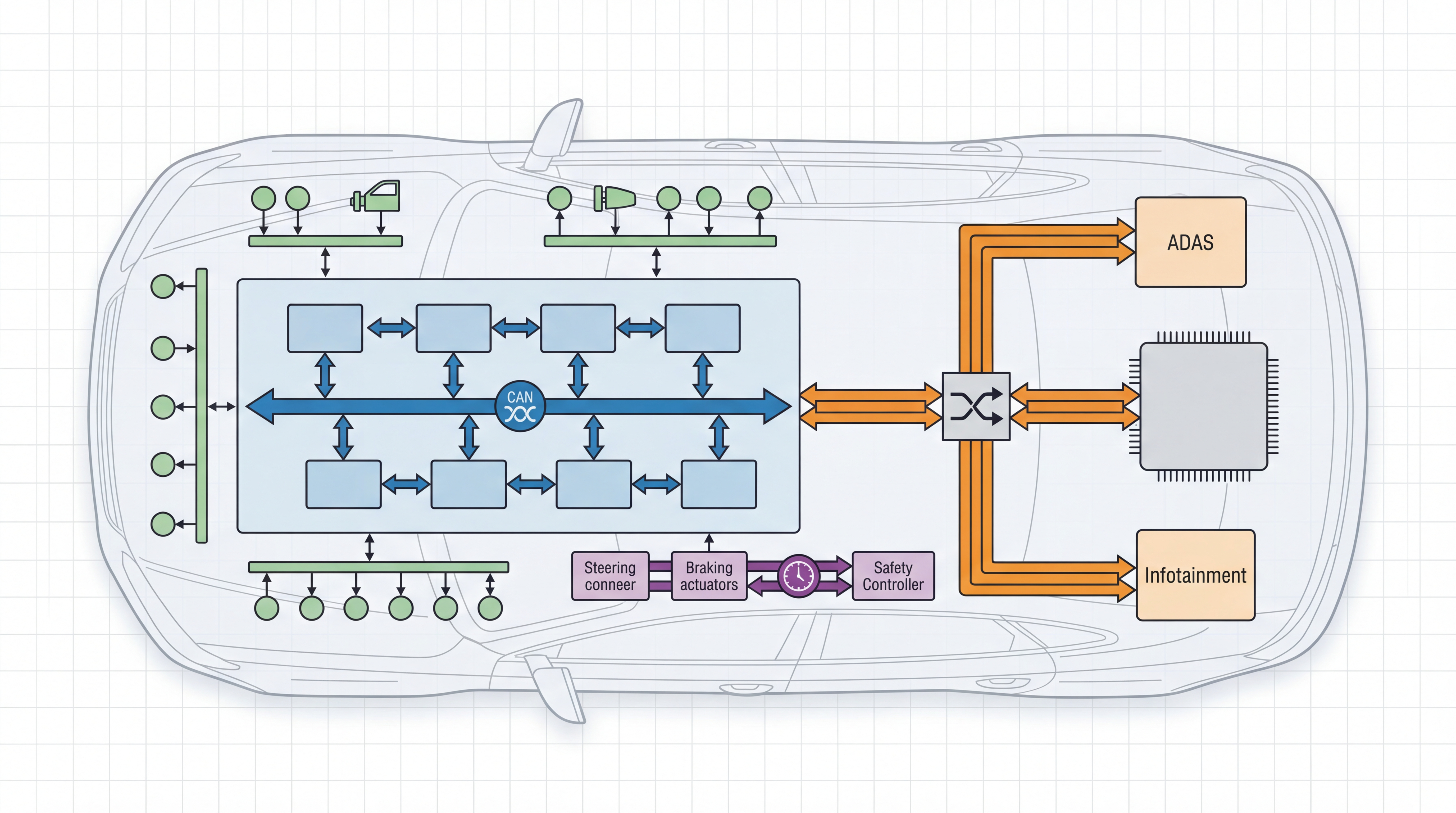
That is why the modern answer is often CAN plus Ethernet, not CAN or Ethernet.
A better rule of thumb
Choose CAN when:
- The network is mostly carrying control and status data
- The messages are small and periodic
- Deterministic priority matters
- Cost and implementation simplicity matter
- You want mature, proven behavior across many ECU classes
Choose something else, or add something else, when:
- Sensor or logging bandwidth becomes large
- You need switched network topologies
- You want IP-native communication and service-oriented architectures
- Central compute and zonal design start reshaping the vehicle
Final view
CAN is not better because it is older and trusted. It is better in the cases where it remains technically proportionate to the job. That is a stronger reason. For control-heavy systems with modest payloads, CAN is still one of the most efficient answers available.